A cleaning robot ROI calculation needs more than floor area and an hourly wage. It needs a comparable manual baseline, a credible estimate of work that can be automated, the human work that remains, and the complete cost of the proposed deployment. The simulator above starts that conversation. It does not turn its gross labour value into guaranteed savings or a purchase recommendation.
This guide is for facilities and procurement teams preparing a floor-cleaning project, particularly English-speaking buyers managing sites in France. It explains the current tool, then provides a method for reviewing a site study. All numerical examples are fictional working scenarios, not customer results, measured C40 performance or robot prices. The currency used by this tool is euros.
What this cleaning robot ROI calculator actually measures
The tool has five inputs: cleanable area, current cleaning hours per day, cleaning days per week, loaded hourly cost and estimated automatable share. It annualises the schedule over 52 weeks. From these inputs it displays current annual manual labour cost, potentially redeployable hours, their gross labour value and a theoretical minimum time for one pass.
These outputs answer different questions. Current manual cost describes your entered baseline. Potentially redeployable hours describe your selected share of that baseline. Their gross value applies your hourly rate to those hours; it does not show money already removed from a budget. The theoretical pass time uses area and a manufacturer maximum, rather than your observed working schedule.
Changing the floor area alone therefore changes the theoretical pass time, not the annual labour figures. Those figures depend on your hours, days, rate and share. This distinction helps you identify inconsistent inputs: a large area entered alongside a very short cleaning schedule needs investigation, not an automatic assumption that the robot can deliver the same standard faster.
The calculation contains no purchase price, finance schedule or maintenance quote. It also does not verify floor suitability or the quality of the completed clean. Keep the output as a labelled scenario and record where each input came from before using it in an internal discussion.
Establish a manual baseline with the same cleaning scope
Start with a named route or zone, not the whole building by default. Record its cleanable floor area, cleaning frequency, expected finish and operating window. Separate spaces outside the proposed robot route, such as stairs, inaccessible corners or areas with a different cleaning process. A building’s gross floor area can include rooms and equipment footprints that are irrelevant to the trial.
Measure the labour currently used to deliver this scope. If two people each spend one hour on the route, the labour input is two person-hours, even if only one hour passes on the clock. Avoid entering a whole team’s shift when only part of that shift concerns the floor-cleaning work under review.
Include preparation and completion activities consistently. If the manual baseline includes fetching equipment and cleaning it afterwards, the robot scenario must also include comparable tasks. Note other duties performed during the shift instead of silently counting them as automatable cleaning. Keep a short observation log with date, area, activity and actual person-time.
Choose representative conditions. A quiet day after an event cancellation does not describe a normal busy week. Where traffic or dirt varies, retain separate observations and explain the variation. The baseline should represent the service you actually need to continue providing, rather than the easiest route a demonstration can complete.
Use an appropriate loaded labour cost
Loaded hourly cost is not simply take-home pay. Eurostat’s explanation of labour costs distinguishes wages and salaries from non-wage employer costs, including employer social contributions. That definition helps explain the input; a national statistical average does not establish the correct rate for your site.
Ask finance or your service provider for a rate consistent with the hours being entered. Identify the included costs and the denominator used to obtain the hourly figure. A cost divided by paid hours may differ from a cost divided by productive cleaning hours. Mixing the latter with a schedule that already includes paid non-cleaning time can overstate the comparison.
For contracted cleaning, use the relevant contract information. The provider’s internal labour cost is not automatically your invoice reduction. A fixed service fee may remain unchanged when a task takes less time. If a revised contract is being considered, keep its proposed adjustment separate from the simulator’s labour valuation until the commercial terms are agreed.
The tool’s starting hourly rate is an editable example, not a benchmark for France or another country. Keep the same currency across labour, operating costs and the eventual quote. If your internal model uses another currency, convert its inputs consistently in that separate model rather than treating the euro symbol here as a selectable currency setting.
Estimate the automatable share from tasks, not optimism
The automatable share is the percentage of current person-hours you are treating as potentially available for redeployment. It is not the percentage of the building a robot can reach. An open zone may occupy much of the floor plan while consuming only a small part of a cleaner’s varied workload. Conversely, repeated floor passes can occupy substantial time within a relatively modest zone.
Divide the baseline into tasks. Identify routine floor coverage, edge work, moving obstructions, spill response, inspections and equipment care. Mark which tasks are plausible candidates for the proposed configuration and which remain human responsibilities. Then use a site trial to revise the estimate. Do not assume that every task inside a mapped area disappears from the human schedule.
Be explicit about how intervention time is treated. You may enter a gross candidate share for exploration and deduct new human work in a separate study. Alternatively, you may enter an observed share already net of that work. Document the choice so that intervention time is neither ignored nor subtracted twice. The simulator cannot infer which convention you have used.
If you have no observations, label the share as unvalidated and try more than one scenario. A cautious sensitivity test is useful; calling an unsupported percentage conservative does not make it evidence. Retain the assumptions that would need to become true for each scenario to work.
Separate robot running time from human involvement
A robot’s elapsed run is not the same as an operator’s working time. Someone may be able to perform another task during part of a run, while still being responsible for preparation, supervision appropriate to the site, interventions and completion checks. Record those activities rather than deducting the entire run duration from the staffing plan.
Count person-time when several employees are involved. A short intervention involving both a cleaner and a supervisor has a different labour cost from an unattended pause. Also distinguish an initial learning activity from a recurring task. Training and first mapping may belong in deployment costs, while daily preparation and routine checks belong in operating assumptions.
Confirm the delivered configuration before assuming that water handling, charging or other actions are automatic. Manufacturer options, building connections and the package quoted for your project may differ. The C40 product page provides the model context; the project documents need to specify which functions and accessories will actually be available.
Ask the trial observer to record interruptions with their cause and duration. A blocked route, access issue or cleaning adjustment may require a different response. Repeated small interventions can matter to the business case even when the robot completes its route. Equally, elapsed waiting time should not all become labour cost if nobody was occupied by it.
Read the C40 throughput reference as a maximum
Keenon’s current C40 product specification states cleaning efficiency of up to 1,100 m²/h. The simulator uses that figure to divide your entered area into a theoretical minimum time per pass. It is a manufacturer-stated reference, not a measurement from your premises or a promise that every route will achieve that rate.
For example, entering a fictional 2,200 m² area produces a theoretical two-hour pass. That arithmetic excludes stops, manoeuvres, route access, preparation and other site constraints. It does not establish a two-hour labour saving or prove that the required cleaning standard will be met in two hours. Repeated passes and different task settings must also be considered in the site study.
Measure accepted coverage over a clearly defined interval during the pilot. State whether the timing includes pauses, servicing and movement between zones. If you compare observations with a published maximum, explain the different measurement boundaries. Combining one supplier’s best-case figure with another supplier’s complete shift time produces an uneven comparison.
For terminology, the English floor-cleaning glossary explains throughput and related concepts. Keep the full specification comparison on the model page. For this business case, the useful question is narrower: can the proposed deployment reliably complete the defined work within the available window, with acceptable human involvement and cleaning quality?
Distinguish redeployed capacity from cash savings
Freed capacity can have operational value without reducing payroll. A cleaner might spend more time on detail work or another zone while total paid hours stay the same. Record that as a planned change in service allocation. It becomes a cash saving only when an actual expense is avoided or reduced and the organisation can explain how that change will occur.
Possible budget changes need their own evidence: a revised supplier fee, an agreed reduction in purchased hours or another identified expense. Do not assume that time released on several small tasks can automatically be combined into a removable shift. Location, timing, contractual commitments and other duties affect whether those fragments are usable.
Keep two columns in the business case. One describes capacity and service outcomes, such as additional areas receiving attention. The other contains cash effects supported by a budget owner. A benefit should not be counted in both columns as though it were two separate financial gains. The simulator’s gross labour value belongs in the first discussion until a real cash effect is established.
This distinction is particularly important when comparing in-house cleaning with outsourced work. Your team may value an improved service even when the invoice stays the same. That can still inform a decision, but the proposal should describe it honestly rather than using a payback figure based on a cost reduction nobody has committed to deliver.
Build a complete ownership and operating cost ledger
Total cost of ownership extends beyond acquisition. The A3 robot system value calculator explicitly separates ownership and operating costs in its general automation approach. Its assumptions concern its own model and should not be transferred to a cleaning robot as evidence of service life, maintenance percentage or site performance.
Build your own ledger from the actual proposal. Distinguish initial equipment and deployment costs from recurring items such as consumables, energy, maintenance and any applicable software or connectivity charges. Identify training, access preparation or connection work where the project requires them. A cost marked included should point to a quote line or written scope; an unknown cost should remain visible.
Record the timing as well as the amount. An initial setup expense is different from a recurring payment. A replacement item may arise later rather than evenly every year. Keep assumptions about its timing labelled until supported by the relevant supplier information. Use a consistent tax basis agreed with finance rather than mixing tax-inclusive and tax-exclusive figures.
Check the alternative too. Existing manual equipment can have its own operating and replacement costs. Include only costs relevant to the decision and avoid counting an already incurred purchase as a new future expense. Use the same service period and cleaning scope for both alternatives so that the comparison answers the same operational question.
Work through a fictional scenario without a robot price
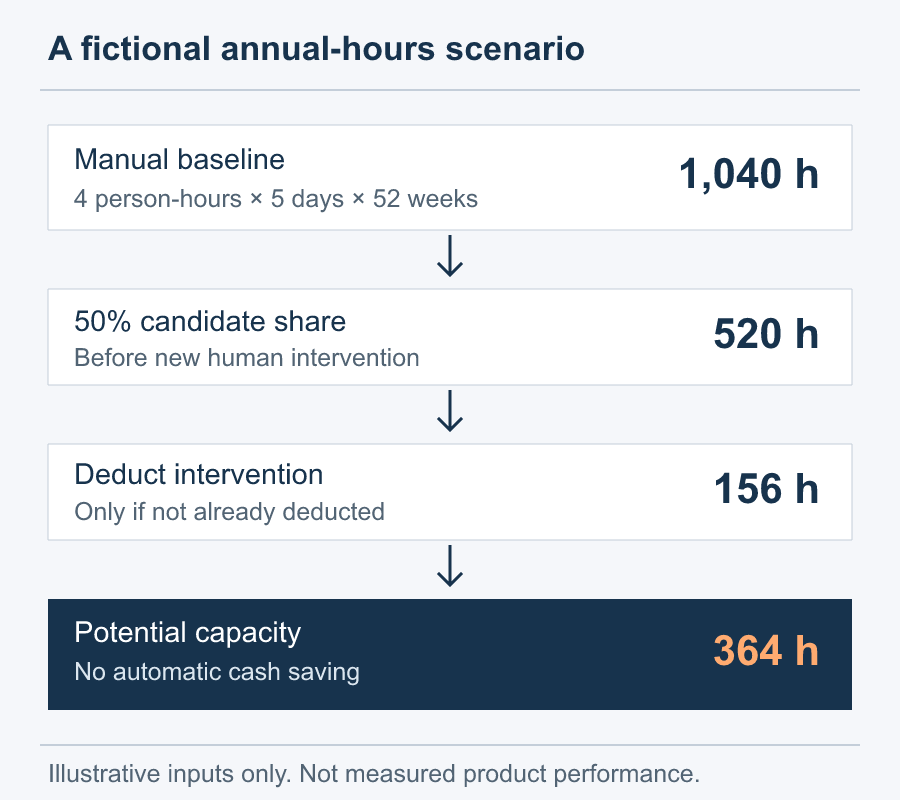
Consider an entirely fictional route requiring four person-hours per day, five days per week. At the simulator’s fixed 52-week convention, that is 1,040 hours annually. Enter a fictional loaded cost of €25 per hour and a gross candidate share of 50%. The outputs are €26,000 of baseline annual labour cost, 520 potentially redeployable hours and €13,000 of gross labour value.
Now suppose the separate study identifies 156 annual person-hours of new recurring intervention work, not already deducted from that candidate share. Under these invented assumptions, the remaining capacity is 364 hours. Valued at the same fictional rate, that is €9,100. This is still a labour-capacity valuation before other operating costs, not a cash saving or complete ROI.
The example deliberately leaves acquisition and other project costs unknown. Substituting an undisclosed price into the model would give a misleading impression of a personalised result. If the organisation keeps its paid hours and uses the 364 hours elsewhere, the payroll reduction from this example alone is zero, even though the revised allocation could be useful.
Write the calculation in stages when presenting it internally: baseline person-hours, candidate share, additional recurring human work, usable capacity, validated cash effect, then project costs. If the candidate share already includes intervention work, omit that extra deduction. This sequence helps a reviewer identify exactly where an assumption changes from an operational estimate into a financial claim.
Use sensitivity analysis before discussing payback
Change one uncertain input at a time before changing several together. In the same fictional 1,040-hour baseline, candidate shares of 40%, 50% and 60% give 416, 520 and 624 gross hours. If the illustrative 156 intervention hours remain unchanged, the respective net capacities are 260, 364 and 468 hours. They are not forecasts or measured outcomes.
At the fictional €25 rate, those capacities have gross values of €6,500, €9,100 and €11,700 before other operating costs. The comparison shows sensitivity to the share assumption, not that the highest value is achievable. In a real trial, intervention work may also change with the route, so the study should consider that relationship instead of assuming it is always fixed.
Simple payback is commonly expressed as initial investment divided by positive annual net cash benefit, provided the timing and assumptions support that simplification. It is different from a return percentage. If there is no positive net cash benefit, this simplified calculation does not produce a finite positive payback period. It should not be replaced with a reassuring number.
For a longer evaluation, ask finance to review cash-flow timing, replacement assumptions and discounting. NIST’s life-cycle costing manual for the Federal Energy Management Program is a methodological reference for evaluating costs over time, not a cleaning-robot performance study. Your organisation’s appraisal rules should determine the final financial method.
Account for opening weeks, education sites and interrupted service
The simulator fixes the annual calendar at 52 weeks. That is a transparent convention, but it may not represent your site. Keep the entered weekly schedule identifiable and adjust the annual model separately when the operation closes, reduces activity or changes cleaning frequency. Do not describe a full-year scenario as a measured school-year result.
For an education site, separate term-time cleaning, holiday activity and special events. Those periods can have different routes and occupied hours. A single blended number may hide the very constraints a robot needs to work around. Use separate lines in the study rather than stretching the daily-hours input until it happens to generate the annual figure you wanted.
Allow for interrupted service without inventing an availability percentage. Ask who handles a failed route, whether alternative equipment is available and what support the proposal includes. The service and support page explains the site’s deployment approach; response arrangements and coverage for your location need written confirmation. An English-language page does not establish service availability in every country.
Compare normal and disrupted operation over the same period. If a human team needs to retain equipment for continuity, include relevant costs once. If you cannot yet estimate a disruption, identify it as an open risk with an owner and a question for the supplier. A blank assumption is more honest than an unsupported promise of uninterrupted operation.
Plan a pilot that measures quality as well as coverage
Before a trial, agree what counts as an acceptable result. Define the route, cleaning task, operating window and checks that the site will use. Observe representative conditions rather than only an empty demonstration area. A completed route on a screen does not by itself show that the required standard has been achieved across the floor.
Record human involvement alongside elapsed time, coverage and rework. Note areas needing attention after the robot pass and explain whether they were inside or outside the agreed scope. Keep the manual baseline available for comparison. If the trial changes the cleaning frequency or task definition, record that change instead of presenting the two approaches as directly equivalent.
The UK Health and Safety Executive’s guidance on slips and trips during cleaning highlights wet floors, appropriate methods, training and supervision. It is a useful safety reference, not a certification of this robot or a substitute for the rules applicable to your premises. Build the local risk assessment and authorised operating arrangements into the trial.
Finish with an evidence review involving the site operator and the budget owner. Document what was observed, what is still assumed and what needs another test. Avoid turning a single successful run into a guarantee for every shift. The aim is a defensible decision about this deployment, including the possibility that a different configuration or continued manual cleaning better fits the site.
Prepare the questions for a tailored ROI study
Send a concise description of the route and current cleaning arrangement through the English contact page. Include the approximate cleanable area, floor types, schedule and known access constraints. You can prepare the simulator without personal information; contact details are only needed if you choose to request follow-up through the separate form.
Ask the study to distinguish measured values from assumptions and commercial commitments. Request a clear account of the selected configuration, recurring human tasks, operating costs and deployment scope. Ask which information remains subject to a trial or quotation. Keep geographic coverage, support arrangements and dates as matters to confirm for your site, not promises inferred from this guide.
A practical opening question is: “Can you review this cleaning scope and show which hours are candidates for redeployment, what human work remains, and which costs and observations are needed for a full business case?” Attach your input record rather than only a screenshot of the largest result. That gives the reviewer a basis for challenging the scenario constructively.
After the study, retain its version, date and underlying evidence. Review actual operation against the same baseline if a deployment proceeds. The useful outcome is not the most impressive calculator number; it is an agreed explanation of the service delivered, the resources used and the financial effects that can genuinely be verified.